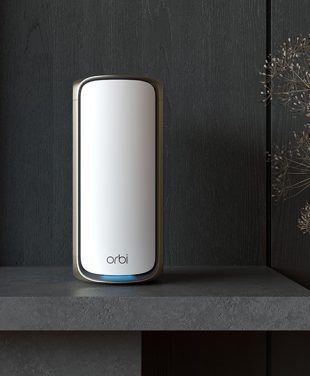
Dead spots, poor reception, and unstable connections, which are common WiFi range issues, may affect your daily activities, such as live-streaming, gaming, and working from home. There are ways you can increase your WiFi range around the house by using hardware products like WiFi extenders or even mesh WiFi systems. The following are some examples of WiFi range extension products by NETGEAR.
The first step towards solving coverage issues is knowing the reasons why your WiFi signal is weak:
Distance from router: The further away you are from the router, the weaker the signal becomes.
Physical barriers: Walls, metal objects, mirrors, and furniture hinder the signal transmission because they can either absorb or deflect it.
Thick walls and interference: Brick, plaster, and concrete can block wireless waves. Moreover, other WiFi networks and electronic devices can interfere.
Router placement issues: Sticking the router into the cabinet, behind a television set, or in the faraway corner of your home will not allow you to distribute the signal evenly. Taking steps to improve router placement can help optimize WiFi signal distribution before adding extra hardware.
Ways to Extend Your Home WiFi Coverage
There are several practical strategies to eliminate dead zones and expand your network reach:
WiFi extenders: Add dedicated hardware to catch an existing signal and re-broadcast it into weak signal areas.
Mesh WiFi systems: Upgrade or enhance your current network through nodes that are connected and make up one unified network.
Router placement improvements: Reposition your primary router to a central, elevated location free of physical obstructions.
Upgrading outdated equipment: Replace older router technology with modern WiFi 6 or WiFi 7 standards to boost baseline range and device handling.
How to Use a WiFi Extender to Improve Coverage
A WiFi extender works by receiving the wireless signal from your existing router, amplifying it, and re-transmitting it to previously unreachable areas. This allows you to effectively extend WiFi range and boost WiFi signal levels in specific rooms without replacing your existing router setup.
To have the best results, you should locate the WiFi extender midway between your router and the dead zone. It needs to be located near enough to your router for a good connection, but far enough from your router to send the WiFi signal to that area. When configuring it, make sure that the WiFi extender has the same security protocol as your WiFi network. To better evaluate hardware options, you can read about the differences between a WiFi extender vs booster to understand WiFi signal boosters completely.
WiFi Extender vs. Mesh WiFi: Which Solution Is Better?
The right approach to expansion depends on the area you have and the performance requirements:
Best Use Cases for WiFi Extenders
WiFi extenders should be used in small and medium-sized homes that need to cover only a couple of spots that have poor internet signal. These are useful for small-scale coverage without having to replace the router.
Best Use Cases for Mesh Systems
Mesh networks are appropriate for medium to large houses and for those that are spread over several floors, as well as in homes where the walls are dense. They can create one network name (SSID).
Coverage and User Experience Differences
Extenders generally provide a dedicated network extension, where you have to switch networks while moving throughout the house manually. With mesh WiFi, there is continuous network connectivity under one network, where traffic is routed dynamically for the best performance. Review our full guide comparing a WiFi extender vs mesh WiFi to compare coverage solutions, or evaluate whether using multiple WiFi extenders or mesh WiFi alternatives works best for your layout.
How to Improve WiFi Coverage in Large Homes or Homes With Thick Walls
Large layouts, multiple floors, and materials used in construction create serious difficulties for ordinary WiFi signals. The thick concrete or brick walls may absorb most of the WiFi signals, leading to no connectivity in the adjoining rooms.
Here, ordinary WiFi range extender devices do not work well due to strong absorption of WiFi signals by the barriers. Installing dedicated mesh WiFi for thick walls or using wired Ethernet backhauls between mesh nodes is the most effective way to improve coverage in large homes with severe structural interference.
Best NETGEAR Solutions for Extending Home WiFi Coverage
NETGEAR delivers specialized devices that will help you cope with any coverage-related issue:
For targeted single-room dead zones: You can use NETGEAR WiFi Extenders to extend your network signal without any difficulties into rooms like your garage or basement.
For whole-home coverage and dense walls: NETGEAR Orbi Mesh WiFi Systems are the perfect choice for high-speed multi-point coverage.
Choosing the right option: If you have to cover one distant room, an extender is your device. If you need to increase the speed across different rooms and floors, a mesh network upgrade is a must.
Frequently Asked Questions About Extending WiFi Coverage
How can I extend my WiFi range?
You can extend your WiFi range by repositioning your router to a central location, installing a WiFi extender, or upgrading to a multi-node mesh WiFi system.
How do I boost my WiFi signal in my house?
You can increase your WiFi strength by removing physical barriers around your router, updating your router firmware, or even using a NETGEAR WiFi extender to strengthen your signal in weak areas.
What is the best way to extend WiFi coverage?
It depends on your home structure; WiFi extenders are effective when you want to enhance your WiFi in one room, while mesh WiFi is more effective for whole-home coverage.
Do WiFi extenders really work?
Yes, WiFi extenders effectively pick up an existing router signal and re-broadcast it, successfully expanding coverage into areas with poor reception.
Is mesh WiFi better than an extender?
It depends on the size of the house, but mesh WiFi would be preferable since it makes one seamless network with automatic switching between devices. However, the extender will create a second network and may decrease bandwidth.
Where should I place my WiFi extender?
The WiFi extender needs to be placed halfway between the router and the zone that lacks signal strength, and it should not be far from the main network signal.