Beyond Speed: How WiFi 7 Defines the Future of Your Connected Home
Today’s homes rely on dozens of WiFi-connected devices working seamlessly — from smart lights and security cameras to laptops, tablets, and VR headsets — all operating with confidence even during the busiest hours.
Learn more about the best router for smart homes by watching the short video below:
When Raw Speed Isn’t Enough
Even high-speed INTERNET feels slow when network congestion creates a bottleneck. WiFi 7 acts as a massive highway expansion, eliminating digital traffic jams so your connected devices perform flawlessly. Several factors can impact network performance, but advanced WiFi technology tackles these challenges head-on for a smoother, more reliable connection.
Weak Signal: Older routers may not support faster bands like 5 GHz or 6 GHz. Distance from the router can also reduce internet speed, as can obstacles like solid walls and floors.
Network Overload: This happens when too many devices share the same bandwidth. Streaming, gaming, video calls, and large downloads can saturate the network. Throw in smart TVs, consoles, phones, tablets, and IoT devices, and you have a WiFi traffic jam.
Interference from Other Devices: Neighbouring WiFi networks compete for the same channels, especially in dense apartments and built-up areas. In addition, microwaves, cordless phones, baby monitors, and Bluetooth devices can all disrupt WiFi signals.
Old or Outdated Hardware: Modern WiFi 7 routers outperform previous generations by delivering faster speeds and superior multi-device Technical Support, offering a noticeable upgrade over standard ISP-provided equipment
Software or Hardware Glitches: Outdated firmware or overheating hardware can cause slowdowns. Routers accumulate errors over time and need occasional reboots.
ISP‑Related Issues: Your plan may not provide enough speed for your household. ISPs sometimes throttle connections (slow down speeds) during peak user times to reduce network congestion.
Remodeling Network Efficiency
Today’s multi-gigabit internet plans are quickly outpacing current WiFi technology. WiFi 7, built on the IEEE 802.11be standard and certified by the Wi-Fi Alliance, sets a new benchmark in home connectivity. The new standard, dubbed EHT for Extremely High Throughput, makes true multi-gigabit WiFi throughout the home a reality with faster speeds, less interference, and better performance for today’s many high-bandwidth devices and online activities.
WiFi 7 benefits fundamentally change the network’s architecture. It introduces wider lanes and, more importantly, the ability for devices to use multiple lanes at once.
Core WiFi 7 Technologies for Home Networks
WiFi 7 supports dramatic improvements for home networking compared to previous generations. It offers wider channel bandwidth, smarter multi‑band usage, and higher‑density modulation to deliver dramatically faster speeds, lower latency, and more stable connections. It also enhances existing technologies like Multi-User Multiple Input Multiple Output (MU-MIMO), Orthogonal Frequency Division Multiple Access (OFDMA), Target Wake Time (TWT), and Preamble Puncturing.
WiFi 7 is built on the IEEE 802.11be standard, also known as Extremely High Throughput. WiFi 7 is especially useful for smart home devices, next-gen gaming systems, virtual reality, and high‑bandwidth 4K/8K video streaming. It enables real‑world speeds far beyond WiFi 6/6E. Here are four core WiFi 7 technologies making a difference.
1. 320 MHz Channel Width
WiFi 7 doubles the maximum channel width of WiFi 6E from160 MHz to 320 MHz, providing for more data-hungry activities. This is particularly useful in the 6 GHz band, where congestion is low. Imagine hosting a movie night with an 8K stream in the living room, multiple smart cameras streaming feeds in the background, and several devices updating apps at once — the network maintains seamless, high-definition performance for every device, even in crowded environments like apartment complexes.
2. Multi‑Link Operation (MLO)
This definitive WiFi 7 feature offers reliability under pressure. MLO allows WiFi routers and devices to connect across multiple bands (2.4 GHz band, 5 GHz band, and 6 GHz band) simultaneously.
Consider a busy family evening with one person on a video call, another streaming, and kids gaming. Your video call continues smoothly without dropouts or buffering, even as others push the network with 4K streaming or competitive online gameplay.
MLO Enhancements include:
Ultra-Low latency
Consistently reliable wireless connections
Faster throughput and backhaul Gbps data rates
Seamless band switching to avoid congestion
*MLO Supported on WiFi 7 Orbi Mesh Systems
3. 4K Quadrature Amplitude Modulation (4K-QAM)
This WiFi 7 router feature increases data density by encoding more bits per signal. It boosts peak throughput by 20% to 4096-QAM compared to WiFi 6’s 1024-QAM. Improved use cases include tasks like 8K streaming and multi-player cloud gaming. WiFi 7 enables activities like transferring large creative files or backing up massive photo libraries to the cloud with noticeably reduced wait times. Content creators and prosumers see the benefit when working across multiple devices simultaneously without interruption.
4. Multi-Gigabit Speed with Real-Time Latency
With real-world speeds up to four times faster than previous standards, WiFi 7 delivers multi-gigabit connectivity that fuels everything from 8K streaming to cloud gaming — no compromises required. It offers ultra-low latency and backward compatibility with older devices by operating across the 2.4 GHz, 5 GHz, and 6 GHz WiFi bands (on tri-band routers). For example, gamers experience stable frame rates during online matches, while AR/VR users enjoy immersive, real-time experiences without hiccups. It also smooths transitions on group video calls, letting everyone speak and react naturally, even when the network is busy.
What WiFi 7 Means for a Modern Home
WiFi 7 is a major leap for the modern home. It brings dramatically faster speeds, lower latency, and far better performance for households packed with smart devices.
With a NETGEAR WiFi 7 system, you can trust your home network to stay reliable and ready as new technologies emerge — delivering a seamless experience year after year.
Benefits you’ll notice:
Smoother 4K/8K streaming even with multiple TVs running.
Faster downloads for reduced latency gaming and large game files.
More stable smart‑home performance (lights, cameras, sensors).
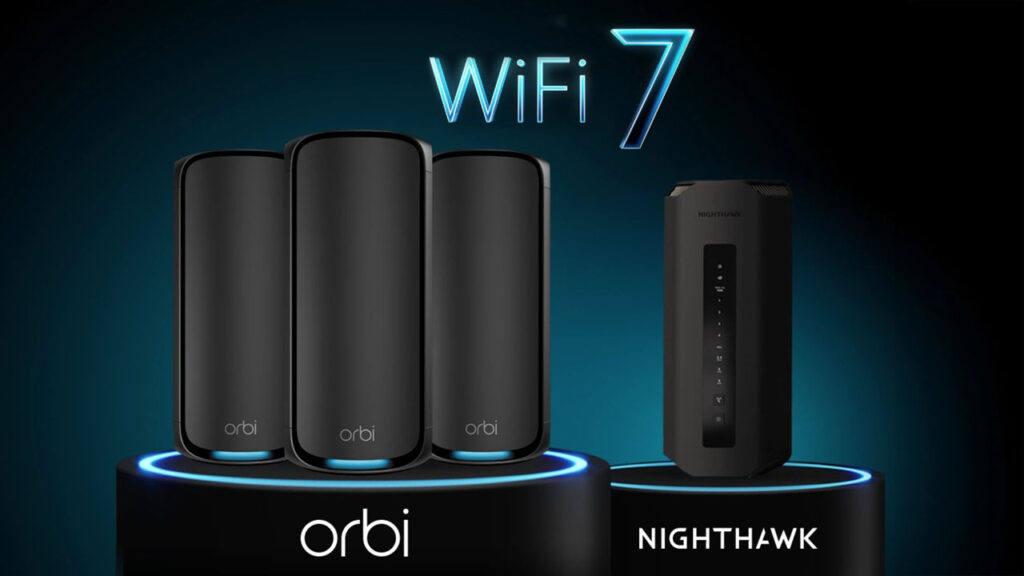
Better whole‑home coverage when paired with WiFi 7 mesh, such as NETGEAR Orbi 970 systems.
Tech Tip: Outside of Multi-Link Operation (MLO) mode, most WiFi 7 devices connect just like previous WiFi generations — to a single frequency band (2.4 GHz, 5 GHz, or 6 GHz) using one channel at a time. In these cases, performance is determined by channel width (20, 40, 80, 160, or up to 320 MHz), local interference, and signal quality.
This is why WiFi 7 routers such as NETGEAR Nighthawk Routers and Orbi Mesh Systems with access to clean 6 GHz spectrum and wider channels — including tri-band WiFi 7 and quad-band WiFi 7 designs — can deliver better real-world wireless networking performance, even without MLO enabled.
Key NETGEAR WiFi 7 Differences
Security: NETGEAR Armor™ protects all connected devices, blocking threats before they disrupt streaming, meetings, or smart home automations.
Design: Intelligent antenna placement and advanced thermal engineering sustain peak loads, keeping your network fast during long gaming sessions or multi-hour video conferences.
Ecosystem: NETGEAR WiFi 7 routers work with existing WiFi 6 and WiFi 6E and earlier devices, so homes can upgrade their network without replacing every device, making the transition to a future-proof network simple and cost-efficient.