
Prove it, then build it
NETGEAR AV powers a medical simulation center that’s setting the standard for healthcare education

Written by:
NETGEAR Enterprise
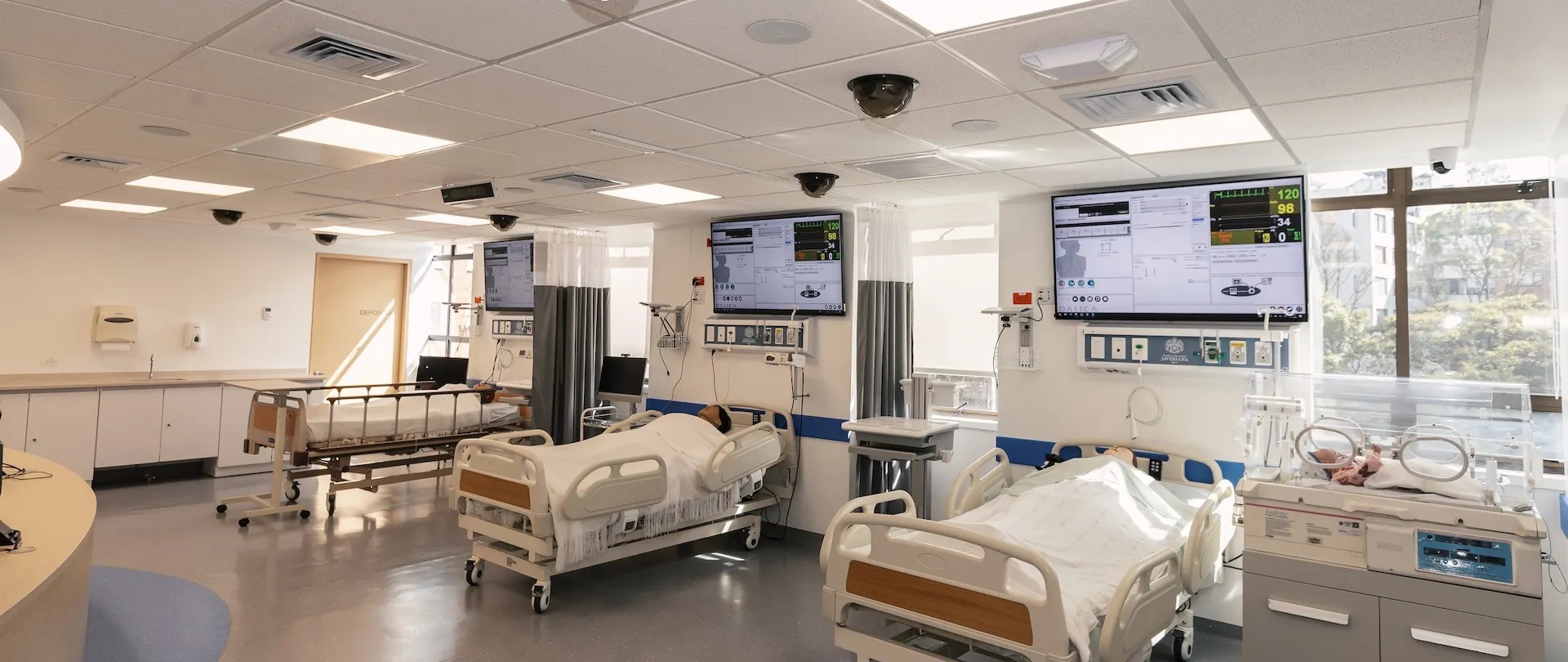
For years, Pontificia Universidad Javeriana in Bogotá operated separate medical and nursing simulation facilities. As healthcare education evolved, those disconnected spaces made it harder to deliver the collaborative, interdisciplinary training that today’s healthcare professionals need.
Working with Integración AV, a Colombian AV integrator, the university transformed an entire academic wing into a unified, state-of-the-art simulation center where students, instructors, and observers can seamlessly collaborate across disciplines. Before the deployment, NETGEAR AV demonstrated the performance, reliability, and simplicity needed for such a mission-critical environment, giving the customer the confidence to move forward.
Today, the new facility delivers more immersive learning experiences, simplifies AV operations, and has become a regional benchmark for medical simulation and healthcare education.
Fifteen years of limits
The original simulation spaces were pioneering when they opened, but by 2023 the university had outgrown them. Medical and nursing simulations were conducted in separate buildings with no shared infrastructure, no cross-disciplinary visibility, and no centralized means for faculty to observe students. Adding a camera or routing a feed to another room required a manual workaround. Recording was unreliable. Debriefing had to happen in the same space as the simulation, with no separation between the scenario environment and the reflection space.
That’s why the university’s Faculty of Medicine decided to transform an entire academic wing of the Acosta building into a unified simulation center where faculty could monitor, record, and debrief across all spaces simultaneously, and where students from medicine, nursing, and other faculties could train together in realistic clinical scenarios.
The resulting scope was significant. The new center would encompass classrooms, a control room, outpatient consultation rooms, critical care units, hospitalization areas, debriefing rooms, and specialized spaces such as surgical rooms, a microsurgery lab, and a laparoscopy training room. Every space needed independent AV capture, with feeds routable in real time to any location in the building.
Designing for doctors, not AV technicians
One of Integración AV’s biggest priorities was making the technology virtually invisible. The system is used every day by medical educators, not AV technicians, so their focus should remain on teaching rather than managing the technology behind it. The result is an intuitive simulation environment that lets instructors focus on the learning experience rather than the infrastructure.
Making the technology simple for educators required a powerful infrastructure working behind the scenes. Thirty-four PTZ cameras and 18 AV recorders capture every simulation, while 47 video encoders and 46 decoders provide flexible video routing throughout the facility. Eleven Shure MXA ceiling beamforming microphones and eight gooseneck microphones ensure every conversation is captured with clarity, even during low-volume clinical interactions. Faculty manage the entire environment through 15 Crestron touch panels connected to a single control processor, making it easy to switch camera views, start recordings, and stream live sessions to adjacent classrooms, all through an intuitive interface designed for teaching, not troubleshooting.
The Crestron-based control layer was designed around the simulation workflows that faculty actually use, rather than around what the underlying AV system requires. That meant the switch network underneath it needed to be rock-solid: any instability at the network layer would surface directly in the control room as lost feeds, dropped audio, or failed routing commands.
The switch that had to prove itself
Integración AV had specified NETGEAR AV switches to handle the project’s demanding mix of IP video, Dante audio, RTSP, and control traffic. The university, however, insisted on its own standard networking brand. It was a reasonable position, as institutions with established IT infrastructure rarely welcome deviations from their approved vendor list, but the standard switches could not support the system as designed.
Rather than accept a technical compromise, Integración AV went further. Over several weeks, the team worked closely with the university’s IT department, NETGEAR, and external experts to demonstrate the technical requirements in precise terms. They lent the university their own NETGEAR switches and ran a live side-by-side comparison. The difference was clear. Seeing the performance gap firsthand, the university agreed to adopt the original recommendation.
“This was an AV-over-IP project. One major challenge involved network switches. We specified NETGEAR switches to meet the project’s technical requirements, but the university insisted on its standard brand. Those switches, however, could not support the system as designed. Over several weeks, we collaborated closely with their IT team, NETGEAR and external experts to demonstrate the technical requirements. We even lent the university our own switches to run a live comparison. Seeing the difference first hand, they agreed to adopt our original recommendation and the system performed exactly as intended.”
— Juan Carlos Gutierrez, CEO, Integración AV
The episode set the tone for the rest of the project. Close collaboration with manufacturers, including NETGEAR, and constant communication with the university’s stakeholders across design, installation, and training meant that when the center opened, faculty could use the system from day one without technical support.
Managing the protocols
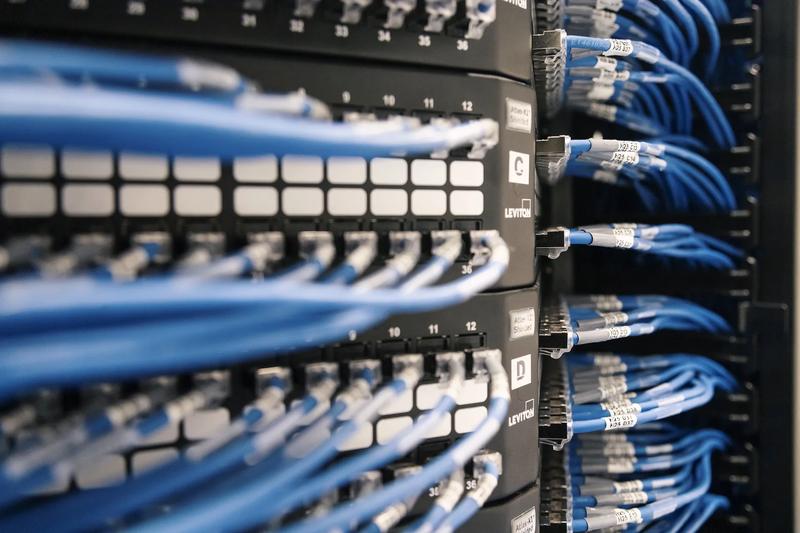
Seven NETGEAR AV switches form the network backbone of the simulation center. The traffic they carry is demanding: video-over-IP from the encoder-decoder matrix, Dante audio from the RDL audio plates and Shure microphone infrastructure, RTSP streams from the PTZ cameras, and Crestron control signals, all running simultaneously across 20 active spaces.
The pre-configured AV profiles in NETGEAR’s AV OS simplified the setup of multicast groups and IGMP configurations that would otherwise require manual parameter-by-parameter tuning for each protocol type. In an environment where six parallel simulations can run simultaneously in the central control room’s Gesell modules, each requiring independent audio isolation to prevent acoustic bleed between adjacent spaces, reliability at the network layer is what allows the directional speaker system, the Holosonic units, and the Audac in-ceiling speakers to perform as specified.
“The pre-configured profiles in NETGEAR’s AV OS made an enormous difference during commissioning. A system this complex, multiple protocols, twenty active spaces, six parallel simulations, could have taken weeks to configure manually. The profiles cut that down dramatically and gave us confidence that every switch was set up consistently from the start.”
— Juan Carlos Gutierrez, CEO, Integración AV
A center that teaches by doing
In the new simulation center, faculty can now run a simulation in a critical care unit, observe it live from the central control room, stream it simultaneously to a debriefing classroom, record it for post-session review, and replay specific moments for group analysis, all from a single touch panel, without technical support.
What began as a simulation space for medicine and nursing students grew into something broader. Students from other faculties, including arts students who take on patient roles, participate alongside medical and nursing cohorts, elevating the realism of clinical scenarios in ways a scripted simulation cannot replicate. The interdisciplinary structure adds the unpredictability of real clinical environments: a future physician practicing under pressure alongside a future nurse, observed by faculty from multiple angles in real time.
The center has also become a revenue-generating facility for the university. Practicing physicians, specialists, and health professionals attend continuing education workshops and certification programs in the space, extending its use beyond undergraduate training and reinforcing Javeriana’s standing as a regional leader in healthcare education.
A benchmark in the making
Since opening, the simulation center has drawn visits from universities across Colombia and Latin America looking to understand how AV infrastructure can support simulation-based medical education at this level. The university regularly invites prospective institutions to experience the space firsthand because seeing it in operation does more to explain the potential than any presentation can.
For Integración AV, the project is a demonstration of what becomes possible when the network layer is built to the actual requirements of the system above it. The NETGEAR AV switches underpinning the simulation center handle protocol complexity and multicast routing while supporting simultaneous high-bandwidth demands of a facility in constant production. The faculty and students using the system can simply focus on medicine.
“This project would not have succeeded without NETGEAR’s support. When we hit the switch compatibility issue with the university, NETGEAR worked alongside us through the entire process, technically and commercially. That kind of partnership is not something you can take for granted, and it made the difference between a project that works and one that doesn’t.”
— Juan Carlos Gutierrez, CEO, Integración AV
NETGEAR products deployed
- 6x NETGEAR M4250-40G8XF-PoE+
- 1x NETGEAR M4250-16XF