03 AI-powered threats: the scam that sounds like someone you know
WHAT’S HAPPENING
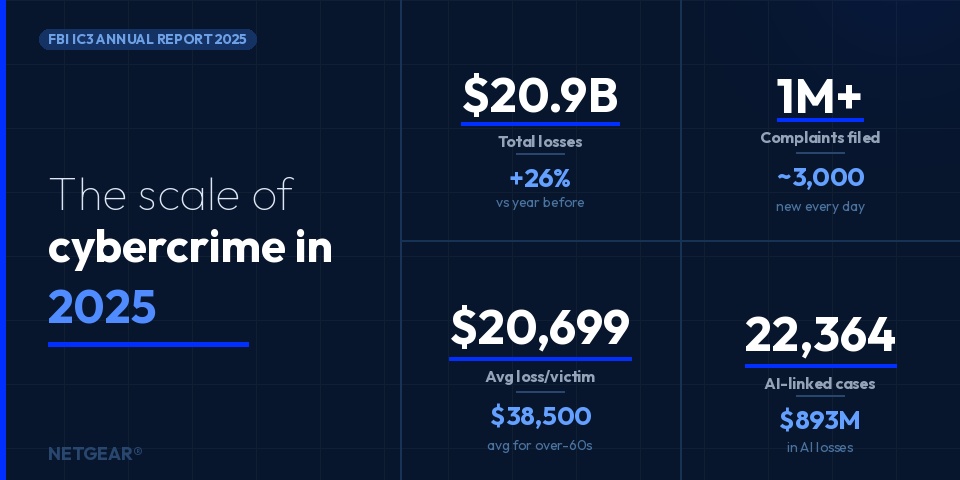
In 2025, IC3 received over 22,000 complaints specifically referencing artificial intelligence, with losses topping $893 million. That number almost certainly understates the problem — most victims have no way of knowing AI was used against them.
AI technology makes scams dramatically more convincing, scalable, and personal. The same criminal operation can now maintain thousands of simultaneous fake relationships, generate professional-sounding emails impersonating your employer, or clone the voice of your grandchild.
How AI is being used against consumers:
• Voice cloning: Voice cloning (“grandparent scams”)
AI tools can replicate someone’s voice from just a few seconds of audio. Criminals use this to call older relatives claiming a loved one is in trouble and urgently needs money. Victims claimed losses of over $5 million to distress scams in 2025.
• AI romance: Fake romance profiles
AI chatbots sustain weeks or months of convincing fake relationships, generating personalized messages at massive scale. In 2025, confidence and romance fraud cost Americans $929 million.
• Deepfake video: Deepfake investment endorsements
AI-generated videos of celebrities, financial commentators, and trusted figures endorse fake investment platforms. Investment scams with a confirmed AI link resulted in losses over $632 million.
• AI emails: Business email impersonation
AI generates convincing emails mimicking company CEOs, HR departments, or suppliers, directing employees to wire funds or click malicious links. Businesses reported over $30 million in losses to AI-assisted scams of this type.
THE RULE OF THUMBIf a call, video, or message creates a strong emotional reaction and urges you to act quickly — stop, hang up, and call the person back on a number you already know. AI-generated voices and deepfakes cannot call you back on a verified number.
WHY IT MATTERS FOR YOUR HOME
The most dangerous aspect of AI-assisted fraud is not the technology itself — it’s the erosion of trust in what we see and hear. Children are targeted through gaming platforms and social media. Older family members are targeted through phone calls that sound exactly like a grandchild in distress. The emotional manipulation is the point.
WHAT YOU CAN DO
8. Establish a family safe word — a code only your household knows that anyone can use to verify a genuine emergency call.
9. Be skeptical of video calls where the lip movements and audio don’t quite match, or where the person refuses to answer unexpected questions.
10. Enable content filtering and parental controls on devices used by children. NETGEAR Orbi routers include Smart Parental Controls to help manage what children can access across your whole network.
11. Read the FBI’s guidance on AI fraud at ic3.gov and NETGEAR’s cybersecurity awareness hub at netgear.com/hub/network/security/cybersecurity-awareness-month-2025/
04 Your home router connects to bigger picture
WHAT’S HAPPENING
One finding in the report that surprises many people: household devices — including home routers — are actively used by cybercriminals to power large-scale attacks. This isn’t theoretical. The FBI issued multiple alerts in 2025 specifically about end-of-life routers — devices that still work for browsing but no longer receive security updates — being hijacked at scale.
How a home router becomes a criminal tool: |
| 01 | Your router runs old firmware or uses a default password
Attackers scan millions of devices automatically, looking for known vulnerabilities and default credentials. No targeting needed — it’s automated. |
| 02 | The router is silently added to a botnet
Your internet connection is used to route malicious traffic as part of a network of tens of thousands of compromised devices worldwide. |
| 03 | The botnet is rented to criminals
Your home’s address helps launch attacks on hospitals, sends phishing emails, or masks the location of fraud operators. The IC3 report categorised botnet activity as a distinct and growing cyber threat. |
| 04 | Every device in your home is at risk
Once a router is compromised, phones, laptops, smart TVs, and smart home devices connected to it can all be exposed. Criminals can intercept logins and financial data passing through the network. |
WHY IT MATTERS FOR YOUR HOME
A router that ‘still works’ for browsing may be running software with known security holes that have never been patched. Firmware updates from the router manufacturer fix these vulnerabilities — but only if the device is still supported and updates are applied.
Beyond the household, running a compromised router means your home’s internet address is contributing to attacks on hospitals, infrastructure, and other people. The impact is not purely personal.
NETGEAR AND AUTOMATIC UPDATES
NETGEAR routers receive regular automatic firmware updates through the Orbi and Nighthawk apps, keeping your network’s security layer current without requiring manual action. NETGEAR Armor, included with Orbi systems, provides an additional layer of active threat detection — blocking malicious sites and scanning for compromised devices across every connected device in your home.
WHAT YOU CAN DO
12. Check whether your router is still receiving firmware updates from its manufacturer. If it’s more than 4–5 years old, it may be end-of-life.
13. Enable automatic updates if your router supports them.
14. Change the default admin password on your router. Factory credentials are publicly listed and scanned for by automated tools.
15. Consider network-level protection such as NETGEAR Armor, which monitors all devices on your network — including smart home devices that cannot run traditional antivirus software.
05 Elder fraud: the fastest-growing threat
WHAT’S HAPPENING
Americans aged 60 and over filed 201,266 complaints in 2025 — a 37% increase from the previous year — and suffered $7.748 billion in losses, up 59%. The average loss for this age group was $38,500. More than 12,000 individuals in this group each lost over $100,000.
201,266
COMPLAINTS FROM 60+ | $7.75B
LOSSES (60+ GROUP) | $38,500
AVERAGE LOSS | 12,444
LOST OVER $100K EACH |
The three most costly scam types targeting this group were:
• Investment fraud: $3.5 billion in losses, including $2.76 billion via cryptocurrency investment scams
• Tech support scams: $1.04 billion, where criminals impersonate Microsoft, Apple, or bank support staff
• Government impersonation: $413 million, where criminals pose as IRS agents, Social Security officers, or immigration authorities
A NOTE ON UNREPORTED LOSSES
These figures represent only what was reported. Many elder fraud victims — particularly those who feel shame, confusion, or fear — do not report what happened. The true scale is almost certainly larger.
WHY IT MATTERS FOR YOUR HOME
Elder fraud is not a distant problem. It happens through phone calls, emails, and text messages — the same channels your family members use every day. The scams that target older adults are specifically engineered to feel credible: a bank call about suspicious activity, a grandchild in trouble, an IRS notice, a Medicare update.
The emotional manipulation is deliberate and sophisticated. The FBI’s data shows that the average elder fraud victim loses more than $38,000 — not because they were careless, but because the scam was designed by professionals to succeed.
WHAT YOU CAN DO
16. Talk about it. A five-minute family conversation about these scams is one of the most effective defenses available. Awareness dramatically reduces susceptibility.
17. Establish a ‘safe word’ or a rule: no one in the family sends money without calling back on a verified number first.
18. Set up parental controls on shared devices, and ensure that network-level filtering is active. NETGEAR Armor blocks known malicious sites across all devices — including the devices used by older family members who may be less familiar with security risks.
19. If a family member has been targeted, report it immediately at ic3.gov. Time is critical for the FBI’s fund-recovery process.
20. Report to the FBI’s Elder Fraud Hotline: 1-833-FRAUD-11.
Your 6-Step Home Security Checklist
The good news: most successful cybercrime exploits predictable, fixable weaknesses. Here are the six steps that will make the biggest difference for your household.
| Home Security Checklist |
STEP 1
Update your router firmware
End-of-life routers are one of the FBI’s top-named vulnerabilities. Enable automatic updates, or check your router’s app regularly. | STEP 2
Change your router’s admin password
Factory-default credentials are publicly listed. Your router’s admin password should be unique and stored somewhere safe. |
STEP 3
Enable network-level threat protection
Antivirus on your laptop doesn’t protect your TV, your kids’ tablet, or your smart doorbell. Network protection like NETGEAR Armor covers every connected device. | STEP 4
Pause before acting on urgency
Every major scam in the FBI report used manufactured urgency. No legitimate bank, government agency, or tech company demands immediate payment by gift card, crypto, or wire transfer. |
STEP 5
Use unique passwords + two-factor authentication
Phishing was the most reported crime type (191,561 complaints). A password manager and two-factor authentication make stolen passwords much harder to exploit. | STEP 6
Talk to your whole household
The people most at risk from the most financially damaging scams are often the least suspicious. A five-minute conversation can be worth tens of thousands of dollars. |
FURTHER READING
For a complete guide to protecting your home network, visit NETGEAR’s security hub: netgear.com/hub/network/security/10-home-online-security-tips/ netgear.com/hub/network/security/cybersecurity-awareness-month-2025/
Sources: FBI Internet Crime Complaint Center (IC3) Annual Report 2025. ic3.gov. All statistics reflect data published in the 2025 IC3 Annual Report.
© 2026 NETGEAR, Inc. All rights reserved.