AV is right in the middle of that shift
At ISE 2026, I had the opportunity to sit down with HETMA, an organization that has quickly become a defining voice for AV professionals in higher education. What stands out about HETMA is not just its advocacy but its holistic perspective. It doesn’t view AV as a collection of endpoints or rooms. It looks at the entire campus experience: how technology supports students from the moment they decide to attend a class through their engagement, collaboration, and learning.
That framing matters because it exposes a hard truth: most AV deployments today were never designed for that level of integration.
Universities run dozens, sometimes hundreds, of systems across teaching, communications, security, and operations. Yet AV has traditionally stood apart, built on proprietary hardware and point-to-point connections that were never intended to scale beyond the room. It worked when the requirement was simple: connect a source to a display, deliver a lecture, move on.
That model doesn’t hold up anymore.
If you take the idea of a connected student journey seriously, then AV cannot remain isolated. It has to become part of a broader ecosystem where systems talk to each other, where data flows, and where experiences are consistent across campus. You can’t do that with HDMI cables and USB devices. There is no path to integration there, no way to manage or orchestrate at scale.
The only viable foundation is IP
AV over IP has moved from being an emerging concept to an operational requirement. What’s changed is not just the technology, but the expectations around it. Universities want flexibility. They want visibility. They want the ability to scale without rebuilding infrastructure every time a new requirement emerges. More importantly, they want AV to behave like the rest of their IT environment.
This is where the conversation becomes more nuanced. Moving to IP is not simply about putting video on a network. It’s about adopting a different way of thinking; one that prioritizes openness, interoperability, and long-term adaptability over short-term convenience. Evolution over revolution.
The AV industry hasn’t always made it easy. There are dozens of standards, protocols, and approaches, each with its own ecosystem and level of adoption. Some are open, some are not. From a university’s perspective, that fragmentation creates risk.
Our role at NETGEAR AV has never been to force a particular path, but to make that complexity manageable. Our switches support a wide range of AV-over-IP protocols, allowing institutions to deploy solutions that make sense for their environment without being locked into a single vendor’s vision. This is a requirement in higher education, where technology decisions have to last.
It also reflects where the industry is heading. There is a growing recognition that interoperability is not optional and requires collective action. That’s why NETGEAR joined openAV.cloud: to help build the open, API-driven framework that lets systems from different vendors exchange information through common frameworks, even if they serve different use cases. The governance work is ongoing, but the direction is clear, and the commitment is real.
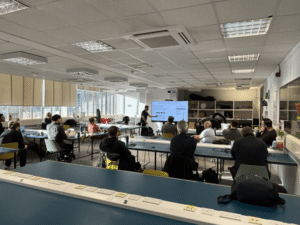
Closed systems don’t scale in open environments like universities
Security, of course, is part of the equation. Higher education networks are, by design, accessible. That openness is fundamental to their mission, but it also introduces risk. What’s often overlooked is that many of the vulnerabilities don’t come from sophisticated attacks, but from everyday behaviors where viruses are being introduced because of human error, and systems are being accessed in ways they weren’t designed for.
An IP-based approach, when properly implemented, gives institutions far more control and visibility than legacy connections ever could. It doesn’t eliminate all risk, but it allows it to be managed in a structured, predictable way.
All of this is happening against a backdrop of financial pressure. Universities are making significant investments in areas like AI infrastructure, where the cost of compute alone can reshape budgets. Energy, security, and facilities all compete for the same resources. AV is no longer insulated from those conversations. As a result, solutions have to be simpler to deploy, easier to manage, and capable of scaling without disproportionate cost. There is less tolerance for complexity that doesn’t deliver clear value.
In that context, the shift to standard networking infrastructure is an economic decision. It allows institutions to leverage what they already understand, extend existing capabilities rather than duplicate them, and evolve incrementally rather than start over.
The HETMA discussion emphasized that the higher education community is not resisting this change. If anything, it’s pushing for it. There is an appetite for more integrated, more intelligent environments. There is also a clear-eyed understanding that getting there requires moving beyond traditional AV thinking.
The building blocks are in place. The question is whether the industry moves and collaborates fast enough to support that vision. There will always be a tendency to default to what is familiar, to treat change as something to observe rather than engage with. But the shift to AV over IP, and to integrated campus experiences, is not a distant horizon. The convergence of AV and IT is not about one domain replacing the other, but about infrastructure that enables connected experiences.
More information on moving beyond traditional AV thinking
Visit our website to see the switches that support esports.
Discover everything you need to know about AVoIP and building an AV network.
Get free support for your AV project from our senior AV engineers.