

WRITTEN BY
Richard Jonker, Global TechnologyExecutiveOrganization, Product,Sales, Marketing, Business Development
- richard.jonker@netgear.com
- Last Updated: September 16th, 2026
Some marketed IBC 2026 as another AI show. Fortunately, that missed the point entirely. The most obvious development in rainy Amsterdam was the industry’s attempt to make software-defined production interoperable, controllable, and commercially viable.
Yes, AI was everywhere, but most of the conversations focused on the infrastructure layers: how applications exchange media, where compute should sit, who controls the data, and whether promised efficiencies hold up in a live production environment.
IN THIS ARTICLE
MXL becomes credible
The Media eXchange Layer was arguably the show’s most significant development. MXL won the IBC Innovation Award for Content Creation after CBC/Radio-Canada deployed it. Unlike many industry awards, this category recognizes projects implemented in real-world environments, not demonstrations seeking a customer.
MXL provides the media exchange layer within the EBU’s Dynamic Media Facility (DMF) architecture. Its job is narrow, but it matters: it lets software functions from different vendors exchange video, audio and timed data without relying on proprietary point-to-point integrations. DMF basically looks like this (AMWA/EBU):
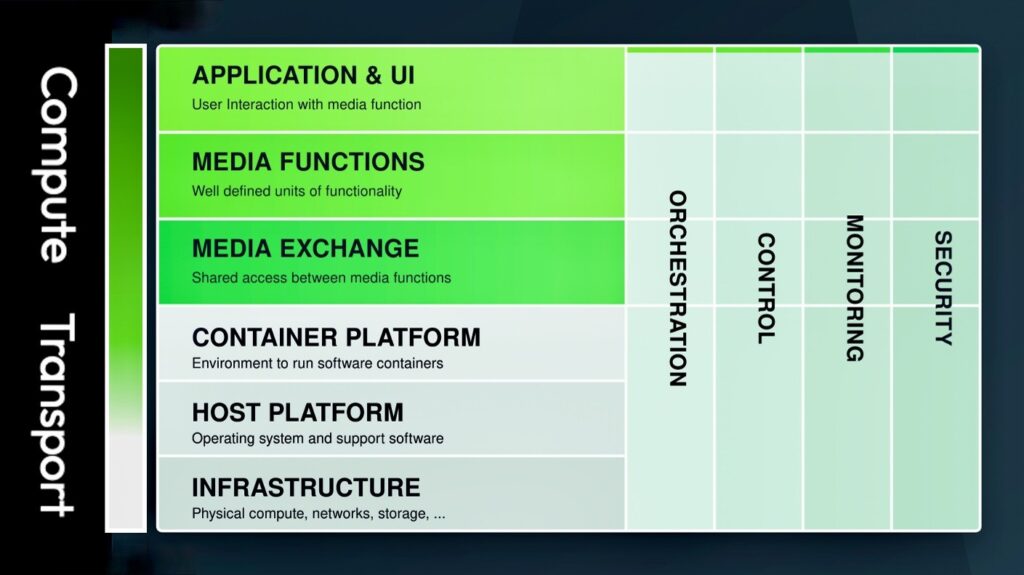
It was wonderful to see the QVEST DMF demo running on equipment and software from 10+ vendors, including NETGEAR. Details in this link.
Our story
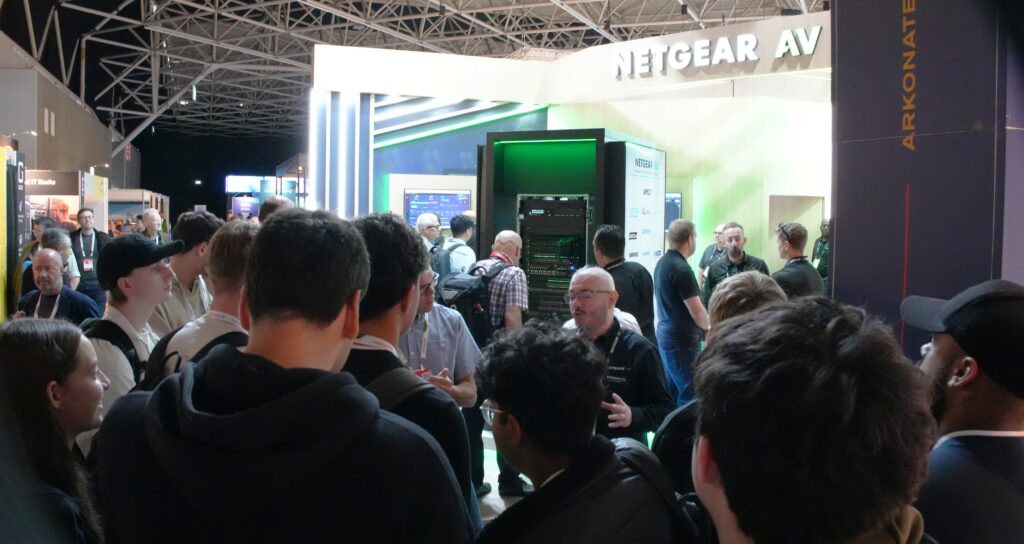
On our own stand, the story was Align Controller. It launched at InfoComm 2026 with five Best of Show awards, and it picked up three more here at IBC. The questions we got were less “what is this” and more “when can I get it.” Underneath it, our switches carry the same timing burden MXL is trying to solve in software: IGMP Plus handles the multicast group management that keeps Dante and ST 2110 streams from colliding, and our M4300 line has been carrying PTP-timed traffic in multi-room AV-over-IP deployments for a while now. Align Controller adds grandmaster and boundary clock functionality on top of that, so the timing story runs from the switch through the controller, not just through whatever software layer happens to sit above it.
 Moving production functions from dedicated hardware onto general-purpose compute is not the most difficult part. Making those functions work together with predictable latency, timing, and resilience is. MXL addresses that gap through an open-source implementation governed through the Linux Foundation and supported by broadcasters and vendors including the BBC, CBC/Radio-Canada, Grass Valley, Lawo, Riedel, NVIDIA and AWS.
Joint task force
Great to see so many companies join the AMWA/EBU Joint Task Force (JT-DMF). Yet another club, but not a hobby club; the work is real.
There are limits and unexplored territory, though. From what I saw:
- MXL does not replace ST 2110 between physical devices, and some elements of the architecture remain under development. RDMA/RoCEv2 adoption is crucial for every vendor that wants to play in this space.
- The BCP008 notifications standard needs to be adopted across all layers, not just by us in the transport department; it also needs to be adopted by endpoint makers and orchestration platforms. Great work from Providius in productizing some of this.
- While NMOS won an Emmy award, which is great recognition, its role in the compute layers isn’t exactly clear. I think the industry agrees on the “why”; we need an address book like NMOS in the virtual part, but there is no firm agreement on the “how” and “what.” We need that clarified urgently. Delay here will slow the transition to DMF/MXL.
- Security is a theme in all six layers of the stack, but we have no firm agreement on priorities or frameworks. This needs work.
- BBC’s R&D team was vocal about the supportability aspect: take a page out of the Enterprise IT book, they said. I think that is a firm call to action.
The good news: DMF/MXL now has code, governance, vendor implementations, and a broadcaster deployment. That puts it far ahead of the many “open” platforms that become proprietary as soon as a customer signs the contract. If DMF/MXL gains adoption, vendors compete on application value instead of squeezing margin out of integration complexity. The AI wave needs this.
AI has matured, but selectively. Is it a tweener?
IBC provided a useful reality check on AI maturity. The big logos and over-the-top claims have gone; we are entering the phase called “reality.”
Captioning, translation, metadata enrichment, search, audio separation, quality control and video enhancement are becoming operational capabilities. They address measurable problems: production time, localization cost, archive utilization and the number of versions a team can produce.
Vizrt/NDI’s work with NVIDIA is a good example of the next category: emerging production capability. They demonstrated a workflow combining NDI connectivity with NVIDIA AI for real-time translation, lip-synchronized dubbing and regional adaptation. In internal testing across ten languages, NDI says the approach carried eight times less video than producing and transporting separate language versions.
That is commercially interesting. One source feed could support multiple localized experiences without replicating the entire production chain. It could expand the addressable audience for sports, news and corporate video while reducing bandwidth and infrastructure costs.
But it’s still a proof of concept, tested with a handful of partners. Translation quality, latency, editorial oversight and the treatment of names, accents and contentious language will determine whether it can be trusted in live use. Growing this into a multi-vendor platform for AI translation plugins seems like a logical next step to me. Also, given the NDI customer base, this could be more of an appliance play than yet another cloud service. Integrated and promising is not the same as “production-proven.”
Agentic AI sits further back. There were assistants, coordinated specialist production agents, and ones that accept natural-language instructions. But the stronger implementations retained human editorial control. Fully autonomous live production remains an ambition, not close to an operating model. Very tool-centric. I liked Small Pixels, an AI video enhancer running on Intel COTS hardware. They can optimize low quality, low bandwidth streams, such as footage from drone cameras.
Cloud loses its VIP status
The public-cloud-first wave from a few years ago was a lot calmer this time. Instead, vendors discussed hybrid deployment, local GPU processing, edge compute, and data sovereignty, including for AI. Cloud has become a deployment option, not a strategy.
This comes from having been burned by cloud bills before. Continuous cloud consumption is not inherently economical for high-bandwidth, latency-sensitive media. The emerging model, like DMF, places workloads according to need: dedicated systems where determinism matters, shared compute where utilization delivers savings, and public cloud where elasticity and scaling cost justify its premium.
What was missing?
There was no defining new consumer format. 8K, XR and virtual production were present, but none drove a wider conversation. Sustainability received surprisingly little attention in the show reporting. Hard ROI evidence was also scarce: plenty of capability claims, fewer disclosed numbers on cost per channel, staffing impact, or payback. The JT-DMF has a Business group. Time to get to work.
That leaves IBC 2026 with an unfashionable but important conclusion. The industry does not need another revolution. It needs a rainbow of systems to behave as one, reliable, production environment, with economics that are visible.