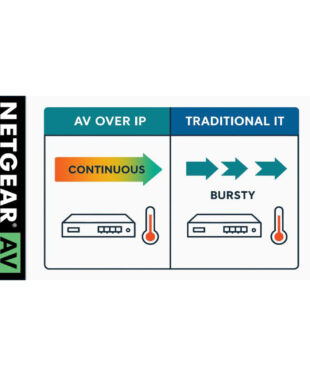
In this blog, I’ll provide an overview of the most commonly used fiber modules – from SFP to QSFP28 – and explain how they perform under heavy AV workloads.
Overview of Module Types
| Module Type |
Max Speed |
Typical Applications |
Expected Lifespan |
Sensitivity to Heavy Load |
| SFP |
1 Gbps |
LAN uplinks, IP cameras, media converters |
>10 years under normal use |
Low – stays cool, slow wear |
| SFP+ |
10 Gbps |
Datacenter servers, AV matrix switching |
5–10 years with proper management |
Medium – heats up under constant 10G |
| SFP28 |
25 Gbps |
4K video transport, switch trunking |
~5 years under intensive use |
Medium/High – generates heat, needs good cooling |
| QSFP (40G) |
40 Gbps (4×10G) |
Aggregation of 10G streams, 8K experiments |
~5 years under full load |
High – 4 lasers generate significant heat |
| QSFP28 (100G) |
100 Gbps (4×25G) |
Backbone/core links, high-density AV |
3–5 years under continuous use |
Very High – extremely sensitive to thermal stress |
What Makes a Module More Sensitive?
- Heat Generation: The higher the speed, the more energy the module consumes—and the hotter it gets. Heat accelerates wear on laser diodes and electronics.
- Component Stress: At higher data rates, tolerances are tighter. A slight degradation that’s harmless at 1 Gbps can cause errors at 25 or 100 Gbps.
- Environmental Factors: Modules in AV racks often operate under less ideal conditions than in data centres. Think dusty air, fluctuating temperatures, and limited ventilation.
What Does This Mean for AV over IP?
In AV over IP networks, SFP+ (10G) and SFP28 (25G) modules are especially popular. They offer sufficient bandwidth for HD and 4K video, but require attention:
- Ensure proper cooling in your racks.
- When in doubt, choose industrial-grade modules, especially in warm or dusty environments.
- Monitor temperature and transmit power using DDM (Digital Diagnostic Monitoring) / DOM (Digital Optical Monitoring).
- Consider preventive replacement after 5 years of intensive use.
QSFP28 (100G) modules are increasingly used in AV over IP, particularly in large production environments and the broadcast industry. These modules operate at the edge of thermal and reliability limits – extra monitoring and redundancy are crucial here.
Conclusion
Not all fiber modules are created equal. Choosing the right type – and the right quality level – helps determine how long your AV network will remain reliable. In the next blogs, we’ll dive deeper into how fiber modules wear out and what you can do to slow down that process.
More information
Visit our website to see the AV Solutions.
Discover everything you need to know about AVoIP and building an AV network.
Get free support for your AV project from our senior AV engineers.