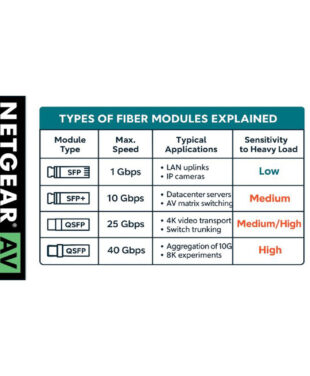
In the world of AV over IP, everything revolves around speed, reliability, and continuity. Audiovisual signals are transmitted as data traffic over standard networks, often via fiber-optic connections using optical transceiver modules such as SFP, SFP+, SFP28, QSFP, and QSFP28. But what happens to those modules after years of intensive use?
At several large theaters where our AV switches have been running for 6 to 7 years, we’ve recently seen failures on fiber-optic links. Not direct cable breaks, but modules losing optical power, links starting to flap, and error messages without clear causes. This led me to an important question:
Do fiber-optic modules wear out faster in AV over IP networks than in traditional IT environments?
AV over IP vs. Traditional IT Networks
In an AV over IP infrastructure, massive amounts of data flow continuously through the network. Think of dozens of simultaneous HD or 4K video streams, live camera feeds, or multichannel audio. Switches and transceivers often run at (near) full capacity around the clock. That’s a world apart from traditional IT networks, where the load fluctuates and there are “breathers” during off-peak hours.
In an office network, for example, a 10G link might only be used occasionally for backups or file transfers. In an AV environment, that same link could be carrying an uncompressed 4K video stream 24/7. The transceiver must operate continuously, resulting in higher temperatures and increased stress on its components.
Heat: The Silent Enemy
Heat is a crucial factor in wear and tear. Modules that operate constantly at high speeds get hotter than those that are only active occasionally. And as is well known in electronics: every 10°C increase in temperature can halve the lifespan. In AV racks without optimal ventilation, this effect can be even more pronounced.
For example: a 10G SFP+ module in an event venue transporting 4K live video day and night will show signs of wear much faster than the same module in an office environment that’s only used occasionally.
Less Margin for Error at High Speeds
AV over IP networks often operate at the edge of what’s technically feasible. A 10G link pushed to the limit for video transmission leaves little room for error. Even slight degradation in the module—such as a drop in laser power—can lead to packet loss or link failure. In traditional networks, there’s often more margin and error correction, so minor wear goes unnoticed.
Environmental Factors Matter
AV installations aren’t always in ideal conditions. Think of a switch behind an LED screen in a theater, with hot lights, dusty air, and fluctuating temperatures. Such environments can accelerate fiber module wear. In contrast, data centers offer stable temperatures and filtered air—a much friendlier climate for transceivers.
Conclusion
AV over IP networks put fiber-optic modules to the test. The combination of continuous load, high data rates, heat buildup, and less-than-ideal environments means these modules can wear out faster than in traditional IT networks. That doesn’t mean they’re unreliable—but it does mean they deserve more attention and maintenance.
In the next blogs, we’ll dive deeper into the different module types, the exact wear mechanisms, and how smart monitoring and maintenance can extend their lifespan.
More information
Visit our website to see the AV Solutions.
Discover everything you need to know about AVoIP and building an AV network.
Get free support for your AV project from our senior AV engineers.
Back to the Introduction