
Built to just work
How NETGEAR AV and Bridge Digital gave Eastern Kentucky University a flexible, campus-wide SMPTE ST 2110 production network.

Written By:
NETGEAR Enterprise
Eastern Kentucky University needed to expand live-event production across multiple venues without adding more point-to-point cabling or rebuilding existing workflows. After comparing the costs, Nashville-based media integrator Bridge Digital determined that a full SMPTE ST 2110 network would be significantly more affordable than the alternative.
Built on NETGEAR AV managed switches, the new network lets operators route any source to any destination across campus without manually repatching cables. It also gives students hands-on experience with the same professional IP workflows used across the broadcast industry.
Growing faster than the infrastructure
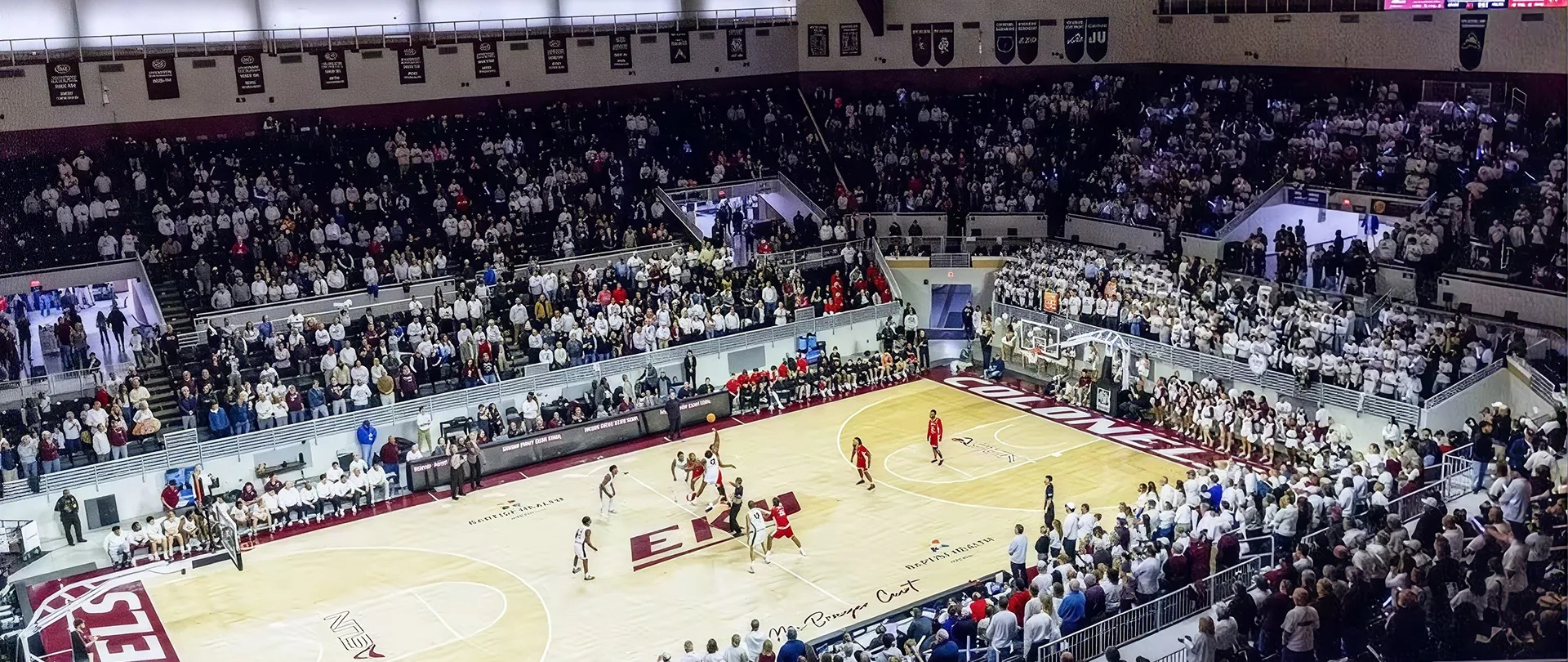
EKU’s production team covers football, basketball, baseball, soccer, and large-scale events at the Center for the Arts. The program was growing faster than the infrastructure supporting it. The existing system relied on point-to-point SDI fiber runs that limited routing flexibility and required manual repatching between events. The Perkins Building and Alumni Coliseum served as the two main production hubs, connected by a 100-gigabit fiber path that went largely underused. The Center for the Arts existed in complete isolation from the control rooms. Every source was fixed, so every change took time. That needed to change. EKU wanted a system that would let any operator walk into any venue and route any source to any destination, without repatching a single cable.
Connecting the campus
Bridge Digital’s created a campus-wide SMPTE ST 2110 network built on EKU’s existing fiber backbone, avoiding the cost and disruption of new cable runs. At each venue, Riedel MediorNet FusioN frames provide local I/O, SDI gateway conversion, and multiviewer feeds. This allowed the university to preserve existing cameras and familiar operator workflows while gaining IP flexibility. NETGEAR M4350 and M4250 managed switches carry the ST 2110, AES67, and Dante traffic across the 100-gigabit backbone.
The network had to handle more than video. Command and control, including the IP layer that drives PTZ camera movements, runs across the same infrastructure. At the center of the signal chain sits a Panasonic Kairos production switcher.
Bridge Digital had been working to integrate Kairos into ST 2110 environments, but affordability remained a challenge as each component added to the total investment. “Using NETGEAR as a major component of the connectivity really drove affordability”, explains Richie Murray.
The project combines NETGEAR M4350 and M4250 switches with Riedel’s legacy MediorNet VirtU 48. The mixed environment works reliably across the campus backbone, protecting EKU’s existing investments. Future phases will expand the NETGEAR infrastructure and introduce dual-switch high-availability configurations as budget becomes available.
Five minutes to working
The project’s turning point came during switch configuration. Aubrey Shamel, Systems Design Engineer at Bridge Digital, had been configuring each switch manually, and small discrepancies kept appearing between units.
“I kept finding things I missed,” she says. “It became very overwhelming and very frustrating very quickly.”
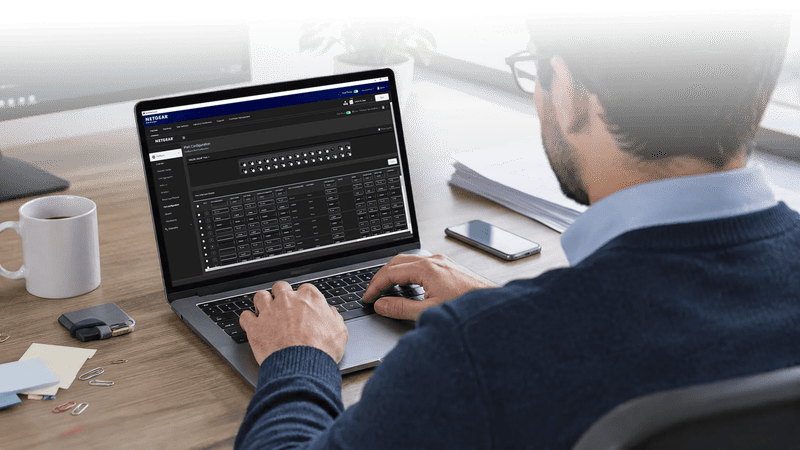
The resolution came on a remote support call with NETGEAR’s Level 3 technical support team. Using the network profile deployment feature in NETGEAR Engage, Bridge Digital applied the correct preprogrammed settings consistently across the network. NETGEAR AV OS™ includes certified profiles developed for more than 600 partners, based on 45 widely used standards.
“By using NETGEAR Engage, we could deploy the right profiles with pre-programmed settings to every switch on the network in like five minutes. And after that, everything just worked.”
— Aubrey Shamel, Systems Design Engineer, Bridge Digital
The support call went beyond resolving the immediate issue. The engineer walked Bridge Digital through the commands he was running, and explained why each issue had occurred. For Shamel, it was as much an education as a rescue, one she built on by later completing the NETGEAR certification courses on the NETGEAR Academy.
“There’s a perception of a barrier for entry because people feel like they have to know a lot to enter the IP space. But the profiles in the NETGEAR AV OS are really clever, and they just work.”
— Aubrey Shamel, Systems Design Engineer, Bridge Digital
Having previously worked with other switch brands, Shamel described the difference as night and day. “The functionality is just as good, the deployment is stronger, and I would be hard-pressed to use a different brand moving forward, because the deployment was so streamlined.”
The walled garden
One of the more deliberate early decisions Bridge Digital made, was how to collaborate with EKU’s IT department. “We worked with EKU to establish the video network as a self-contained system, managed entirely by video engineers”, explains Murray. “It kept things clean and simple for everyone, including IT.”
Treating the video network as a self-contained environment gave production engineers the control they needed without adding another specialist system for the central IT team to manage. Murray sees this as a repeatable model for other organizations moving to IP production.
Third-party friendly
One feature that proved unexpectedly useful was NETGEAR’s accommodation of third-party SFP and QSFP modules. The project used optical transceivers from a range of manufacturers, and the switches handled them without issue.
“NETGEAR is a lot more receptive to QSFP and SFP personalities that aren’t locked in. Some switches are not that friendly, and it can block you in a way that can be very frustrating. The fact that NETGEAR is third-party friendly is really nice.”
— Aubrey Shamel, Systems Design Engineer, Bridge Digital
In one case, active optical cables that failed to negotiate correctly between another switch brand and Kairos equipment in the signal chain - handshaking at half the expected speed - worked without issue when using NETGEAR switches, avoiding a larger problem during production.
Still running
The network went live for EKU’s first football game of the season and has operated reliably ever since.
EKU can now connect venues, route signals, and expand production without repatching its infrastructure. The video team can manage its own environment, while the IT department avoids additional operational complexity. Existing cameras, workflows, fiber, and legacy equipment remain valuable parts of the system.
Students also gain experience on a professional-grade SMPTE ST 2110 workflow, developing skills that translate directly to the industry they are preparing to enter.
From its first football game to receiving NAB’s Project of the Year award in the Production category, EKU’s network has delivered the flexibility, reliability, and hands-on learning environment the university set out to create.
The network at a glance
- M4350 managed switches
- M4250 managed switches
- NETGEAR Engage
Third-party key components
- Riedel MediorNet FusioN frames with MuoN A processing SFPs
- Riedel MediorNet VirtU 48 (legacy, mixed-environment deployment)
- Panasonic Kairos IP production switcher
- Riedel Bolero wireless intercom
- Riedel PunQtum digital partyline intercom