IN THIS ARTICLE
What Mesh WiFi Options are there?
There are a lot of options when it comes to configuring your home WiFi network for top performance. And as wireless technology continues to improve, that number of options continues to grow with companies releasing upgraded WiFi equipment that deploy these innovations in a variety of ways.
Dual Band Mesh Systems
These systems offer transmission and shared data between 2.4 Ghz and 5Ghz frequencies to connect between the satellite, routers and all devices.
Orbi Mesh WiFi Systems
One example is the NETGEAR Orbi Tri-Band WiFi Mesh System, a pioneer and our flagship offering for the WiFi mesh market. Unlike competing dual-band mesh systems that transmit all data on only the 2.4 GHz and 5 GHz frequencies, Orbi features a third backhaul radio band for dedicated communication between the router and the satellites in the network.
Nighthawk Mesh Systems
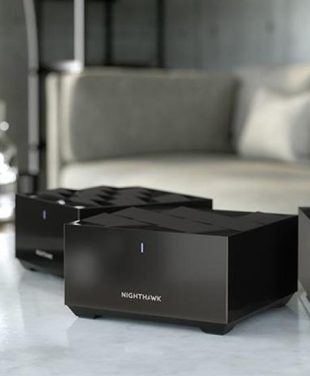
As a result of Orbi’s success, NETGEAR continued its trailblazing trajectory by developing Nighthawk Mesh. Like Orbi, Nighthawk Mesh also features tri-band capabilities that extend WiFi coverage How to Extend WiFi Coverage in Your Home. But this then raises the questions: How are these products or solutions different? Which is best for my home network?
Let’s compare dual-band mesh systems (like Google WiFi) to Nighthawk Mesh (a tri-band mesh extender) and Orbi (a tri-band mesh system) by evaluating their performance in these key areas: speed, coverage, and compatibility.
 |
| (add Orbi 370 Series to cart) |
Which Mesh Systems Deliver the Most Speed?
| Features | NETGEAR WiFi 7 Mesh (e.g., Orbi) | NETGEAR WiFi Router (e.g., Nighthawk) |
| Coverage | Multiple nodes blanket large homes with consistent signal | Strongest near the router; weaker in distant rooms |
| Best For | Large homes, multi‑floor layouts, thick walls, many devices | Apartments, small–mid homes, simple layouts |
| Performance | Consistent speeds everywhere; ideal for roaming | Highest peak speeds near the router |
| Scalability | Add more satellites anytime | Limited to single access point |
| Device Capacity | Excellent for dozens to hundreds of devices | Good for moderate device counts |
| Setup Complexity | Slightly more involved | Simple, fast setup |
| Cost | Higher (multiple units) | Lower (single unit) |
 Choose the Right Orbi for you:
Orbi Buyer’s Guide Compare the latest Orbi Mesh WiFi Systems.Find My Orbi Tool Answer a few questions for an Orbi recommendation.
|
| (add Orbi 370 Series to cart) |
What Mesh Systems Have The Best Coverage?
| Dual-Band Mesh Systems | Dual-band mesh systems can provide seamless, extended coverage to average-sized homes. However, because they lack the third dedicated backhaul radio band, the 2.4 GHz and 5 GHz frequencies become congested, which negatively impacts signal strength and coverage. Deploying additional WiFi nodes in a dual-band system does expand coverage, but it also has negative consequences since it reduces the speed. |
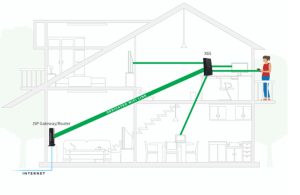
| Nighthawk Mesh Systems | Nighthawk Mesh also provides seamless, extended WiFi coverage. However, its signal strength is dependent on your WiFi router. Current routers with the latest WiFi technology deliver stronger signals over larger areas. A Nighthawk Mesh extender like EX8000 is a powerful partner to your Nighthawk router. Adding another mesh extender creates an ideal arrangement for a larger home when you need more WiFi for more devices and in more places, without compromising on speed. |
| Orbi Mesh Systems | Orbi WiFi Systems provide seamless, extended WiFi coverage in even the most palatial of homes. As a multi-point system, you can easily deploy additional WiFi satellites to expand coverage to every room. |
Is Mesh WiFi Compatible With All My WiFi Devices?
| Dual-Band Mesh Systems | The compatibility of a dual-band mesh system varies by its model and manufacturer. |
| Nighthawk Mesh Systems | Nighthawk Mesh works with any WiFi router, from the most basic dual-band ISP router to the latest tri-band routers. It is also backwards compatible with older WiFi devices. |
| Orbi Mesh Systems | As a comprehensive tri-band mesh system, Orbi comes complete with a state-of-the-art WiFi router and satellites that are backwards compatible to work with all your WiFi devices. |
And the Mesh Winner Is…
Tri-band and dual-band mesh systems and mesh extenders all seek to provide seamless WiFi coverage to home networks using innovative wireless technology. However, the success of their deployments contrasts significantly.
Generally speaking, dual-band mesh systems don’t deliver the fastest speeds or extended coverage that are standard in tri-band mesh products. They are therefore not recommended for modern-day home WiFi networks.
With that said, then, which tri-band mesh product is better suited for your WiFi home network: Nighthawk Mesh or Orbi? Ultimately, it depends on your router and your needs.
If you have a more recent WiFi router or have to use an ISP provided box due to contractual obligations, then Nighthawk Mesh delivers extended coverage and faster speeds at the lowest cost. Flexibility to create a mesh system with any brand router is another reason you would go for the Nighthawk Mesh. Nighthawk Mesh extenders are compatible with ISP gateways, as well other routers on the market.
If, however, you have an outdated WiFi router, such as one installed by your ISP, then it’s likely time to upgrade to the Orbi Tri-Band WiFi Mesh System, an easy scalable solution that can grow with your WiFi needs.
So There You Have It. Mesh Mashups Unmeshed.